Total Pageviews

Thursday, 7 June 2012

Confusion in Bougainville is our fate

Thoughts of Leonard Fong Roka

Be a Bougainvillean inside-out if you really want history to know you were a Bougainvillean.

Here I am referring to the ideological side of life: politics, economics and social aspects of daily living in Bougainville.

Bougainville and the rest of Melanesia were socialist nations ever since time immemorial. But the dawn of European colonization of our world turn all things to barbaric acts of self-hatred. A Melanesian today dislikes himself and his past tranquillity despite the fact that he carries with him imprints of Melanesian designing in his psyche. This is awful insanity!

...carries with him imprints of Melanesian designing...

I claim that our systems of social existence as social or socialist because, the Melanesian philosophy of life was centred on the ‘relationship one had with the next person’. The harmonious co-existence or maintenance of peaceful and mutually beneficial relations was significant.

In our modernized global village, many of our poor developing countries in the Pacific vow to Eurocentric dictates as the way to survival of our governments. One thing to note here is that we have being designed to hate ourselves by westernization. The dependency syndrome!

One proverb that touches so much is from the Dalai Lama: ‘Open your arms to change, but don’t let go of your values’. In all aspects of national survival, every person or state has the right to design its own destiny and not to subsume into western ideologies that are unrealistic to Melanesian application.

In the book, Bougainville Nationalism, Mamak and Bedford (1974:44) wrote:

‘The reason why we are confused is because we have no identity. Ever since the white man came he has failed us up. We have lost all our sense of values. We have no proper goals. We follow the white man’s ways blindly, we imitate him readily, and yearn for his goal—money—because whiteness is a sickness and it has poisoned our minds.

Before white man came we had an ideology which was socialist. Today we are asking in what way the government can help the people. This is why I hate the white man. He did not bother to use our traditional values to help us develop. As a result we don’t know where to turn…He has led me to believe that I lack an ideology and the ability to stand up today and say to myself, ‘Yes, this is the type of government I want, this is the economic system I want; and this is the social system I want.’

To these heart breaking paragraphs, I turn to ask: As a Bougainvillean, who am I? Why am I a Bougainvillean? Is it Because of colonialism?

In our bipolar world today, where we have the peacefully rising China and the rapacious hegemonic West, a Pacific developing state has the room open for a paradigm shift in its politics to identify a system that best serves the national interest. The developing China is an opportunity that a state can look to for help after ridding itself from domestic political fluid which is one problem area in the Pacific islands community.

I say this, because China is a state rising with a foundation firmly based on ancient traditional Chinese philosophy of Confucianism and adopted a walking stick that is the European liberalism in a sea of capitalism dominated globe.

To sum up, for us to solve the Bougainville conflict and built a better Bougainville where our children will enjoy and be proud of, is to look back to our past. The values of harmonious co-existence amongst individuals, clans and so on are vital to develop a regional political, economic and social governing system and laws for Bougainville.

 In my dreams, I see that change in Bougainville is easy to gain with a leadership that has will power to sacrifice for the common good of Bougainville. It is this leadership that must firstly; eradicate the curse of stubbornness and self-preservation that had polluted the Bougainville conscience.

Wednesday, 6 June 2012

The Prophesising and Resisting the mining of Pangkirangku

By Leonard Fong Roka

Pangkirangku was a hill that was situated at the very location of the present day idle Panguna Mine pit in Bougainville. It was the hunting ground for the Guava and the Moroni people who mostly intermarried to each other.

Oral history stands that the area was colonized by people not in one wave band but, in single persons through marriage, especially. That is, a family can be a first settler of a territory example, Moroni village, and then later goes back to their place of origin and seeks a wife for a male son and bring her with them to Moroni. She does not return but settles with her in laws and expands her clan. In due course, her children inherit land through the many land ownership related rites of passage.

Site of Pangkirangku (Panguna pit)

But with the dawn of the Bougainville secessionist and anti-mining conflict in 1988, the militant leader late Francis Ona had taken high publicity as the major landowner of Pangkirangku. This is too negative a taint on the identity of the true owners of Pangkirangku.

The late Francis Ona belongs to the Kurabang clan and his group of immigrants into the Guava village is second in line (measuring migration waves in oral history is fluid. It might be decades apart or a generation) to the first group of Kurabangs.

Thus, the first group owned much of the Pangkirangku (turned Panguna later) ridge that hosted the ore bodies that attracted CRA to mine it for Papua New Guinea and sparking the Bougainville crisis that killed thousands of innocent Bougainvilleans.

In the first wave of Kurabangs, were born two brothers, Dumenu and Anthony Ampe during the WW2 period. These brothers, the rightful and undebatable owners of the majority proportion of customary land in the ridge and braes of Pangkirangku.

As children the brothers and their other siblings enjoyed their jungle, wild rivers and gardening with parents. Later in 1950s, the eldest Dumenu began a retard. That’s what many referred to him as, but he was a prophet.

In this state of mind, he left Guava and erected himself a makeshift shelter a safe distance away to the west of the main village on the Guava-Kokore ridge. There, close to his abode, he selected a high point on the trail and began digging the earth with his bare hands. Days he dug and nights he dug. When travellers caught up with him he cried calling, ‘I am destroying your beautiful land and your future is not good’.

A few years before the CRA geologist who officially discovered the copper mineralisation on Pangkirangku, Ken Phillips arrive, Dumenu was death.

His young brother, Anthony Ampe, now took over the actual fight against the CRA and BCL operations from the 1960s and into the 1970s.

Anthony Ampe at Arawa market (Photo: Rodney Banas)

He was noted as the only land owner who faced the money-tyranny with verbal attacks, tears and the use of his body to block equipment from moving on; in every work location, he was felt.

He protested solo in the work places and in the offices. His one act so famous in the mining gossips of Bougainville was in the early 1980s. To the north-east of the pit, was the sacred site belonging to Ampe’s family line, this was the boulder called locally as the Kontemoi. The company was blasting the boulder to pieces from the southern cliffs when Ampe confronted.

He stoned the machinery and the operators and engaged some police in a fight which Ampe a muscular built prevailed.

After minutes he got himself on a rock the size of a 200 litre drum that being pushed by a dozer and halted the progress. There he stood weeping and verbally attacking the workmen who were lost for words from the weight of guilt and shame.

From morning to the sunset he kept tapping the rock with his full bodily mass til the rocked was gobbled by the soft earth. Disturbing the operations, he left for home.

To this very date, the mention of Pangkirangku in Anthony Ampe’s presence, hurts and he cries freely (the mining like his brother had psychologically affected him for life). His name for Papua New Guinea is katua niugini (in Nasioi meaning, incapable New Guinea).

Tuesday, 5 June 2012

Torokina's WW2 Ordnance Clearance Mission in Pictures

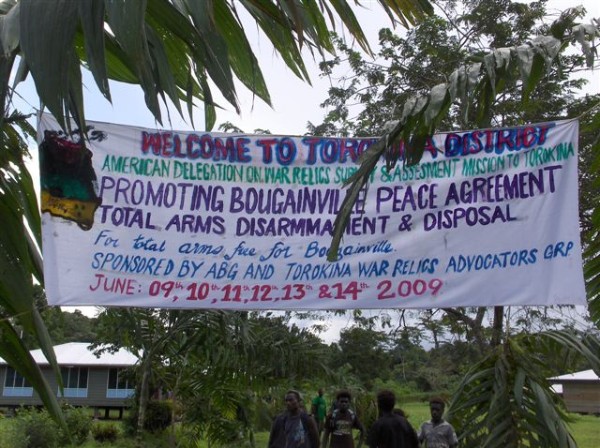
In April 2009, the PNG and ABG governments made a joint request to the US embassy seeking assistance to clearing the Torokina area from arms and ammunition.

Torokina map in WW2 showing concentration of US military sites

In response an American team of weapon specialists led by Charles A. Stonecipher left for Torokina on mission costing $1 million in September to October of 2009. They identified 144 sites with surface contamination that warranted clearance of the unexploded ordnance (UXO).
Barge ladened with UXO clearance equipment heading for Torokina

Welcome in Torokina

US ordnance expert shares with a local WW2 carrier

Tour of duty around Torokina

WW2 mortar cells

Arial bombs

Artillery shells still intact in a pile left in the 1940s

UXO infested jungles

Local with his re-conditioned rifle

This re-conditioned Owen gun, lost automatic fire capability but still fires singles for a Bougainvillean

Locals show a range of weaponry

Chained ammo and personal stuff like helmets

Japanese items further inland from the then US controlled coast

WW2 Ammunition for the local market

UXO team labour with their find

UXO placed in sand for safe transport to detonation areas

The project is not now active. It did not clear the whole Torokina area of UXO and other items that still threatens the lives of Bougainville.

Retrieved from: The European Shareholders of Bougainville Copper (http://www.bougainville-copper.eu/bougainville-problem-2.html) 

NOMINATE IN BOUGAINVILLE

By Aloysius Laukai
A total of Sixty nine candidates have nominated to contest Bougainville seats in the 2012 PNG General Elections.
After close of nominations yesterday, 13 candidates nominated for the Bougainville Regional seat currently held by FIDELIS SEMOSO.
For the South Bougainville seat currently held by the Minister for Bougainville Affairs, Stephen Pirika Kamma 14 candidates have nominated.
For the North Bougainville open, 20 candidates nominated to contest the seat currently held by MR. LOUTA ATOI.
And Central Bougainville Open seat which is currently held by the Communication Minister Jimmy Miringtoro would be contested by 22 candidates.
In the Regional seat candidates are JOE LERA the former Commissioner for South Bougainville Region in the Bougainville administration, woman candidate and former ABG member for Central Bougainville representing Central Bougainville women, MAGDALENE TOROANSI, another unknown woman candidate, LYNNETTE ONA, Former ABG Lawyer KAPEATU PUARIA, former clerk of PNG National Parliament, SIMON PENTANU,SAM CAROL,JIMMIE MOSE, ALBERT MAGOI, former ABG Vice President in the Kabui led government, JOSEPH WATAWI, Former BRA Commander, ISHMAEL TOROAMA and Buka Air-condition man, HENRY ONSA, Bougainville Musician and former ABG Member representing Ex-combatants in North Bougainville, MARCHELIN GETSI and including the sitting member FIDELIS SEMOSO.
The Central Bougainville Open seat will be contested by mostly heavy weights in the Central Bougainville Region.
They include the sitting member and Communication Minister, JIMMY MIRINGTORO Lawyer THOMAS TAMUSIO, Strong women advocator and woman leader THERESA JAINGTONG, Former Central Bougainville Member SAM AKOITAI, MARTIN MIRIORI,WESLY THOMAS, Former UNDP Boss for Central Region JUSTIN BORGIA, former ABG member for KOKODA, RODNEY OSIOCO, former ABG member for Rao, LEO REIVASI, Chairman of the Panguna Landowners Association, CHRIS DAMANA, CHRISANTO KOROKORO, Arawa Businessman SIMON BARANANKO, the current ABG member for Kongara who resigned to contest the National seat, DOMINIC ITTA, LAURIE PATRICK and WILLIAM REINHART.CLARENCE DENCY,DOMINIC DIUKA,JOE TARUNA,LOHIAL BUAIA NUAU,Meekamui strongman CHRIS BAO,MATHEW KUSA and JOSEPH SIPU.
For South Bougainville the fight would be between two heavy weights the current Sitting member and Minister for Bougainville Affairs, STEPHEN KAMA PIRIKA and former member for South Bougainville MICHAEL LAIMO the others are PETER MANUKA, TIMOTHY MASIU the media director for the East New Britain Governor, Businessman, PETER BANA,JOSEPH MOIKUI, DAVID KAUA,JOSEPH PARUM, THADEUS KAILE, former Local Level Government Officer PATRICK HEROMATE, RAYMOND KAKAPONI, GABRIEL PANGTEI, MICHAEL ANUGU,PETER CHANEL TENGKA.
For the North Bougainville seat, The current sitting member, LOUTA ATOI is being challenged by many new and aspiring leaders starting with ISAAC HEKEN THOMPSON,DONALD HAMAU TATO,RACHAEL OPETI KONAKA, Buka businessman WILLIAM NAKIN,NOEL SAREI,HILLARY TSUNNO, Bougainville’s Movie star, ALBERT TORO, the current ABG sitting member for Hagogohe who resigned to contest this seat, ROBERT HAMAL SAWA, DOMINIC TOAPALA TUMARR, JOHN SISIASI, former ABG member for Atolls, TAEHU KEALI PAIS,GERARD MASA,SYLVESTER NIU,JOHN BITI BULE,DAMIAN KORA, MICHAEL HAMOUN ROSS and the former ABG member for Peit and Bougainville Tourism promoter, LAWRENCE BELLEH, former Education Boss, TONY TSORA, former ABG Deputy Speaker, FRANCESCA RIANNA SEMOSO.
Campaigning throughout Bougainville has been quite with candidates and the supporters slowly gearing up for aggressive campaigns towards the end of Campaigns.
Ends

Retrieved from http://bougainville.typepad.com/newdawn/page/2/

Monday, 4 June 2012

Responding to a anti-Bougainvillean comment


By Leonard Fong Roka

In June I published an article ‘West Papua Conflict is Asian Infiltration and Rape of Melanesia’ in blog Keith Jackson & Friends: PNG ATTITUDE (link http://asopa.typepad.com/asopa_people/2012/05/west-papua-conflict-is-infiltration-rape-of-melanesia.html (also available in http://lfongroka.blogspot.com/2012/05/west-papua-conflict-is-asian.html ) outlining my views of the problems faced by West Papuans under Indonesia as we in Bougainville, had gone through under Papua New Guinea.

These were my thoughts from a Bougainvillean background, but surprises I had from a myopic Papua New Guinean and he was just a symbol of million people blinded by institutionalised indoctrination. The few educated will go against my thought thinking that the intellectual see-saw is massed to their side. Sorry!

This is what one Papua New Guinean said after quoting me:

'After the dawn of decolonisation, West Papua found itself in Indonesia; Bougainville in Papua New Guinea; and New Caledonia struggling for self-determination from French rule'.

What a lot of rubbish Leonard!

Either by default or design, Bougainville has and still is an integral part of PNG. This is in contrast to your continued assertion that PNG, somehow, had colonised Bougainville.

Every ethnic group in PNG are distinctively different in complexion and culture, and Bougainville is no exception.

I served time working in Panguna during the pre-crisis years and found from the majority of the Bukas then that even they see themselves different to the rest of the mainland Bougainvilleans, with the exception of the Teop-Tinputz people.


Gabuar - The lines you quote are rubbish because you and your place (wherever it is) has not seen relatives dying before your eyes struggling to defend their subjugated life as I did. That is that civil conflict in Bougainville.

My thinking was moulded in a trouble-torn Bougainville and its anti-PNG discourse. And you will never change me.

In ethnicity, yes there is difference. But, you your mention of Buka is myopic.

Stand a Buka islander and New Guinean together and compare them, there is a extreme contrast (race). Check the Buka and a Wakunai, they are one for they are Solomonese.

Bougainvilleans are different from New Guineans!

I start by requoting my words again: 'After the dawn of decolonisation, West Papua found itself in Indonesia; Bougainville in Papua New Guinea; and New Caledonia struggling for self-determination from French rule'.

‘Bougainville in Papua New Guinea’ (quoted), what do I mean? Before 16 September 1975, Bougainvilleans knew who they were and set out resistance not to be part of PNG; and even, in the very first week of September declared the ‘Republic of North Solomons’.

But still, despite the tears they shed in the many rallies and protests they held, my people were never respected in accordance to the many conventions and so on created by the United Nations to protect human rights, we were often called ‘cargo cultists’. And my island ended up in the deep shit of PNG.

We were nobodies, so the coloniser forced its way into our heart to develop the Panguna mine to fund and modernize its buffer state PNG whilst keeping us ‘media’ rich and marginalized just like the West Papuans under Indonesia.

This is colonization in disguise! Why? Because, immediately after independence, PNG granted us a ‘useless’ provincial government system to shut our mouths thinking we were retards.

PNG did not bother to review the parasitic Bougainville Copper Agreement on the people of Bougainville. It did not protect our rights on our apical home island, which our elders were protesting as early as the 1950s, by measures such as a Vagrancy Act and so on. But, let aliens to take over our land with their squatter settlements and suppressed us shamelessly on our Solomon island of Bougainville.

Now let me comment on the concept of ‘Bougainville is an integral part of Papua New Guinea’.

Many say, a constitution is a supreme document governing an independent state like PNG. It is all powerful and above the parliament. Yes, I should agree but not in a PNG context, but in a European environment, I will accept this idea.

Where is this Bougainvillean rebel coming from? Well, democracy is said to be a ‘government of the people, by the people and for people’ (Abraham Lincoln). Thus, there is a reciprocal bonding between the state and the people. However, if we explore the PNG experience, the supremacy of the constitution is in a see-saw because the people—the very sources of power—have not yet tasted what nationhood is all about!

In the 1970s or 1980s, the late Saddam Hussein used the phrase ‘Full bellies make no noise’ as a tool to nationalize foreign oil companies in Iraq. Here, we see the idea why I say that the people must be satisfied in order for a government to remain stable. This then determines the supremacy of a constitution.

The years 2011-2012, we have witnessed the parliament and the judiciary playing around with the ‘supreme’ constitution of PNG for personal gains. We see corruption in public office, in the streets; crime on the rise, people insecure so they are importing guns for the welfare of the tribe or the family. Where is the constitution?

If the term ‘integral’ is to be valued in PNG, there must be harmony and satisfaction as to how PNG is functioning.

We consider ourselves as one because of indoctrination by the few elites holding onto neo-colonialist stigma over our conscience and benefit at the top as the rest goes astray without hope.

Thus, whether you like it or not, every province or tribes are still far from being an integral part of Papua New Guinea. They are still on the road to that goal!


Saturday, 2 June 2012

A rivetting documentary about a proud people


BY WAYNE COLES-JANESS

  BOUGAINVILLE OUR ISLAND, OUR FIGHT is a powerful film about an indigenous people taking up arms for independence to protect their culture and stop the ecological devastation of their lands.


This multi award winning documentary is about one of the last wars for independence.

It smuggles us across borders into the world of the besieged people of Bougainville.

During the civil war, cut off from all humanitarian aid and invisible to the western media, their only resource was their resolve to fight for independence in an attempt to preserve their culture and environment.

This is the only documentary of the longest war in the South Pacific. A war that resulted in the deaths of 20, 000 people who live just two hours from Australia.

You can find out more here - http://itunes.apple.com/au/movie/bougainville-our-island-our/id397699853


retrieved from link: http://asopa.typepad.com/asopa_people/2012/06/a-rivetting-documentary-about-a-proud-people.html

Friday, 1 June 2012

Impact of a Panguna Mine Pit Lake

By Leonard Fong Roka

The Panguna Mine pit is about half a kilometre deep and two kilometres wide. Today it sleeps idle a scar of suffering in the heartland of Bougainville. Kilometres of gravel stretches and slopes surrounds the pit to the west and to the east, stands the imposing Pen hill (organic rock) brae that was butter-cut to the side of the central regions of the Crown Prince Range by the BCL; added on, is the rock spree and slip that slides to settle into the pit.

Panguna mine pit

In the early days of the BCL operations (1970s), the naturally occurring crust water systems that sprouted from the numerous sections of the pit, was drained by a pumping station mounted at the lowest section of the pit through a network of steel pipes to the surface. This was a costly exercise.

To minimise the cost of operations, BCL engaged a foreign specialized company to open a drainage tunnel network. A location right at my family’s piece of land was selected (in 2004, I erected my house right at the entrance and lived there ever since).

Pit Drainage tunnel entrance

From the entrance, the Panguna pit is around 6 kilometres to the north-east, but the company cut the tunnel straight east towards the Kongara area more than a hundred kilometres away but cut it short from continuing and redirected it towards the pit.

After mapping out their position some 3-400 metres below the pit, the company punched from the bottom of the pit, 1.5 metre in diameter steel pipes piece by piece through the crust to the tunnel below. After reaching it, the punched in 3 more and the job was done. The strategy was, every time the pit expanded down, a piece of the steel was cut. The pit experienced from JULY 1985 no nightmare of water built-up.

My concern today is the concentration of wash-out from the sides of the pit at the bottom. It threatens the intake vaults (of course, two were already permanently shut off). The remaining two, are near from their fate. And when they are shut, the Panguna pit will turn into a huge lake of water.   

The only lowest point that the reservoir can drain is through the main pit entry wing and out into the Kavarong River firstly, through the public vehicles pit-area entry tunnels. This water, however, washes away with it, tonnes of gravel that hosts the pit workshop section to the secondary crusher (a distance of half a kilometre).

Public vehicle pit area access tunnels

The flow of this washout from the Panguna Pit Lake shall further energize the naturally running Kavarong River along the ‘V-shape concrete Kavarong waterway that is already in a state of a long pond system after blocked by a huge landslide from the direction of the BCL Concentrator Zone (beyond this point, right below new Dapera village, the V-shaped water system is in better condition).
V-Shape Kavarong water way. Workable area beyond Dapera

Landslide affected zone of the Kavarong waterway near the BCL concentrator

Water filled sections of the water way near the former BCL light vehicle workshop


These combine forces of nature, will block the V-shape water way, around new Dapera and divert the water, through the lower section stretching from the secondary crusher to the B-40 workshop, into the more lower belt (5-10 metres lower) hosting the conveyor belt system that former supplied the spreaders kilometres away to the south-west that poured gravel into the Tumpusiong Valley (my home).

Spreader area

All these areas just mentioned, of course, before the mine came into existence, were the sky or tree tops enjoyed by the winged animals. The waste gravel from the pit area filled in the valley and today made it possible for human occupation.  Some dozens or hundreds of metres below is the pre-mining river bed of the Kavarong River.

Gravel brae above Pirurari village

Once the genesis is done, we face the catastrophic action of nature that is the Kavarong River trying to relocate its old bed as it washes with it billion tonnes of waste gravel down into the Tumpusiong Valley.

The washout will first consume the Pirurari village and move on into my section, where the Kavarong River is still searching for its apical bed.

Pirurari Village below


The Panguna-Jaba section of the highway into South Bougainville will be off once and for all. Affecting the economically vibrant South by cutting off the access to the Bougainville east coast areas like Arawa and Buka, for Bana district, this is the access not too costly from driving through Siwai to Buin and to Arawa.

For the Tumpusiong valley where many of us are now settled near the highway to the Southern districts and close to the banks of the polluted Kavarong River, this will cause us to resettle to the higher altitudes with some costs.

Tumpusiong Valley

This is a disaster soon to be unfolded for the Panguna District and the Bana District in South Bougainville.